By Owen Coggins
Owen Coggins recently held a Leverhulme Early Career Fellowship in Social & Political Sciences at Brunel University London, having previously worked as Researcher for Music Therapy charity Nordoff Robbins, and completed a doctorate in Religious Studies & Music at the Open University. Owen’s ethnographic research focuses on how audiences engage with religion and ideology through popular music, often focusing on metal, noise and experimental music.
The world of contemporary art is always a somewhat unhinged juxtaposition of deeply critical creative practice and the wild excesses of luxury capitalism. The Venice Biennale is among its largest, most prestigious and storied shows, and adds a further strange dimension of nationalism with its garden of pavilions for different countries. This is both anachronistic and extremely current: two of the pavilions still read JUGOSLAVIA and CECOSLOVACCHIA over their doors referencing nation states from another century, while recent Chinese and some Gulf State pavilions are evidently about projecting particular visions of those countries’ place in the world. Geopolitical issues were particularly sharpened this year, with resignations, strikes, protests and interventions concerning the Russia and Israel pavilions especially.
I visited in May and kept an ear out for interesting uses of sound, noise, music, silence, and amplification. In this instance, there was a musical reference in title given to the Biennale, In Minor Keys, by its curator Koyo Kouoh, who died in 2025 in the process of working on the show. In her words, the phrase indicated a wish to
‘shift to a slower gear and tune in to the frequencies of the minor keys. Because, though often lost in the anxious cacophony of the present chaos raging through the world, the music continues. The songs of those producing beauty in spite of tragedy, the tunes of the fugitives recovering from the ruins, the harmonies of those repairing wounds and worlds.’
Sonic aspects, though, are often slightly awkwardly adopted in gallery spaces: despite multimedia practices entering contemporary art and the Venice Biennale many decades ago, the visual remains privileged. Sometimes in the Giardini’s central exhibition and Arsenale spaces, sound bleeds between spaces and its not always clear whether you’re, for example, looking at a sculpture while hearing sound that is intended as an inextricable part of it, or just overhearing the audio from a totally separate piece nearby. The temporality of sound (and video) is often also ambivalently managed, so you don’t know if its important that you hear the audio component from start to finish, or just drop in and out whenever. For this reason, vague ambient droning that offers an absorbing texture is often an effective (if rather standardised) response to the challenge. An insect-like hum, for example, pervaded the room displaying María Magdalena Campos-Pons’ beautiful giant glass flowers, the sound helping to imagine them in their own outsized rainforest world.
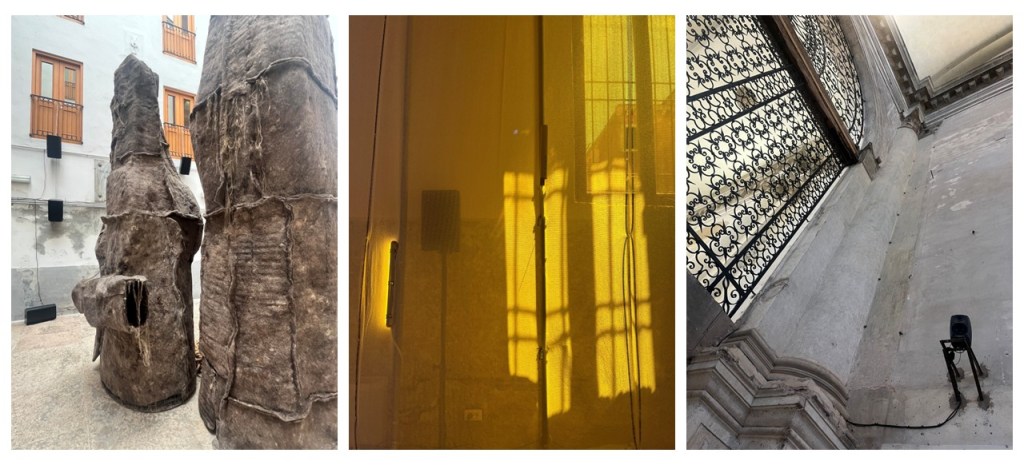
Frequently, art pieces that involve sound have no mention of it in the textual explanations, but this time the reverse was also evident: art without obvious sonic dimensions was described with sound metaphors, with all kinds of unsounding things newly resonating with echoes of one another presumably in an attempt to link to the overarching theme. Sometimes music was included in rather stereotypical ways, as in several uses of solo piano and opera singing that appeared almost as sonic icons announcing “this is music” rather than doing anything musically or sonically interesting themselves.
Another way that amplification ‘appears’ in multimedia art is in how the visual dimension of speakers have, or more frequently, haven’t at all, been considered, beyond placing black boxes on brackets or stands at the edges of exhibition spaces. Dispensing with everything but this was Taus Makhacheva’s piece as part of the UAE pavilion: in its small white cube, dozens of little speakers hung from cables, each muttering aloud readings of various ‘apologies for not replying sooner’ emails. The collective murmuring of the low-level cacophony took the sting out of the silent office banality, and walking through the room was a surprisingly human absolution from the hovering stress of the guilt-laden messages.
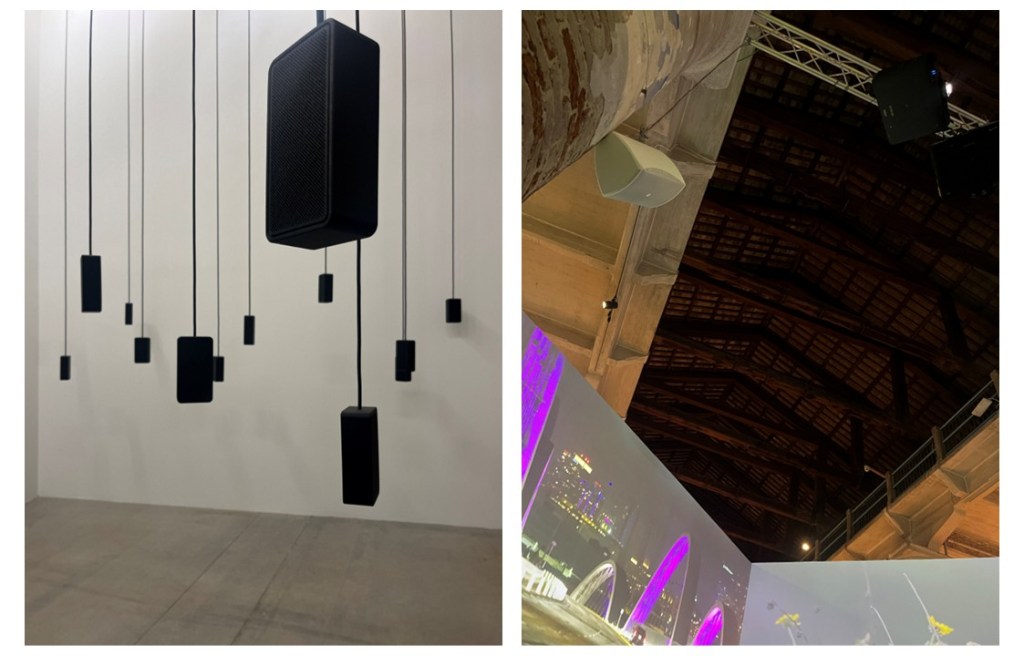
Cauleen Smith’s large installation commissioned Black composers to make versions of LA poet Wanda Coleman’s poems, with four-channel video showing slow vignettes of Los Angeles life and nature. The Wanda Coleman Songbook was a brilliant “multisensory meditation on Los Angeles” which, as the title suggested, was more auditorily engaged than simply creating a soundtrack for the visual. An LP of the same songs spun on a turntable, encased in glass with no audio cables attached, and I was disappointed not to be able to discern “the earthen scent of Griffith Park” which apparently “wafts through the installation,” but the overall impact was affecting.

Silence was deployed interestingly in some cases, with the Egypt pavilion switching the usual tendencies to accommodate speech and forbid touching. Visitors were instead invited to be silent but encouraged to place their hands on a huge upturned curved bowl- or shell-like metal object, such that the quiet (and low lighting) helping to focus tactile attention on the slow, heavy shifting of its balance. Nick Cave’s large sculptures were also silent but suggested sound: not just because of his better known career as a musician, but with large bell-like structures in several. But the matt-black human forms with flowers coming out of horns for heads seemed a bit didactic and inelegant, the best one incorporating instead some beautiful handpainted gramophone horns in a structure that made them appear like flowers. Nearby, Himali Singh Soin and David Soin Tappeser’s large weavings of soundfiles were wonderful in filling a cavernous space with silent sound as part of their piece Subcontinentment, but the audio component when later encountered was a rather overwrought voiceover about the title concept.
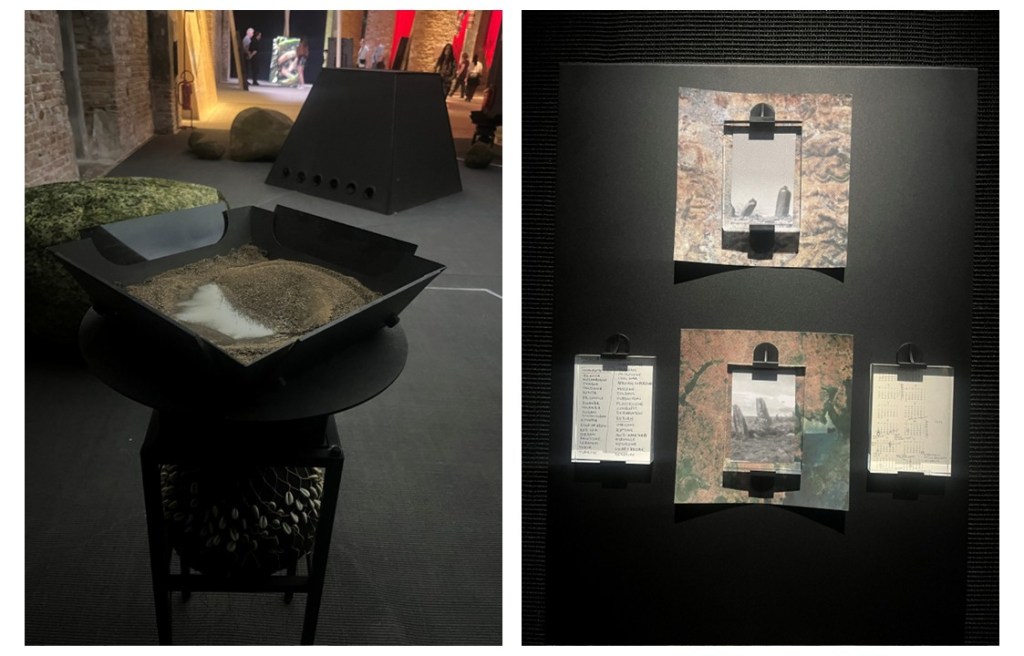
By far the most striking use of amplification I saw was by South African artist Nolan Oswald Dennis. This involved several speakers on top of four short sculptures, with the speaker cones facing upwards, and filled with dirt, sand and grit, forming miniature coastlines, hillsides, plains and valleys. These were set in motion by processed sonifications of seismic data from sensors across Africa, the groaning and creaking soundscapes shifting the earthy material and causing the tiny banks of dirt to shake and drift and the stones and seeds to skitter. Sonification often involves something of an interpretive sleight of hand, in that data can be processed and accurately represented with a range of sounds, but particular kinds of sounds might be chosen that already fit certain cinematic or ideological expectations and conventions: while they may accurately represent the original data source in temporal sonic form, it may be difficult for listeners to parse what is data and what is arbitrary aestheticisation. Here, tectonic readings became audible frequences, and vast continental geographies were suggested in the arrangement of handfuls of rattling dirt, with such obviously altered scale offering an absorbing opportunity to feel and think about subterranean vibration. In the artist’s words, this was to transform infrasound and its associations with surveillance, military and extractive uses into an opportunity to instead enter “the vastness of the sound, where the polyphonic hum of the earth orients us towards a polyvalent conception of the plural worlds (Indigenous, black, queer) that it bears.” This was linked explicitly in a small accompanying visual piece on the wall to a list of current liberation struggles for people of colour from Sudan to Congo to Palestine, and days of the year commemorating dates in these histories, as suggested in the title Black Earth Calendar. Amplification here being used to do what art should do: creating an unusual opportunity to sensorily grasp radical possibilities at the edge of conceptualisation.
Video 1. Black Earth Calendar by Nolan Oswald Dennis, Arsenale.
All photographs by Owen Coggins, all quotations from La Biennale di Venezia Short Guide catalogue 2026.

