By Gabrielle Kielich
Gabrielle Kielich is a Senior Research Fellow in Music at the University of Huddersfield. She is a popular music scholar with research interests in live music and touring, women and the electric guitar, the history and culture of British punk and rock music, music and everyday life, and qualitative interviewing. She is the author of The Road Crew: Live Music and Touring (Routledge 2024) and has a PhD in Communication Studies from McGill University. She also has a background in journalism and worked for magazines in the US focused on music and culture.
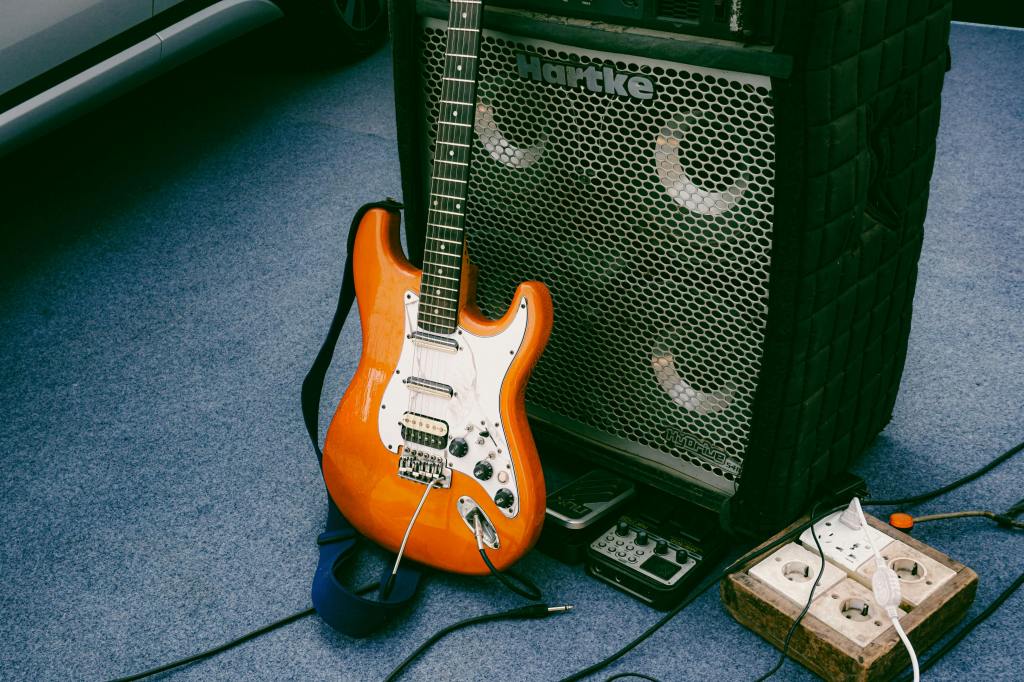
In honour of Women’s History Month, this blog highlights some of my preliminary research on how amplification matters to the musical practices and experiences of women electric guitarists.
As minorities in a male-dominated field of practice, women have historically been underrepresented and minimally understood as electric guitarists. While this is gradually changing, much of the discourse and representation has tended to present them as either an exception or a novelty. My research works to expand the narrative about women electric guitarists, their practices and experiences, as well as to normalise them in this role and better integrate them into both the history of popular music and the electric guitar.

Technology and Gender
Scholars have argued for the importance of including a range of technologies in studies of gender and music (see Kearney 2017). Like the electric guitar, technology more generally has historically been strongly associated with masculinity. This masculinisation of technology has been cited as among the social factors that act as barriers or obstacles to women becoming electric guitarists (Bayton 1997, Bourdage 2010). It has also led to assumptions about women’s competence with technology and their value as consumers of music technologies (Herbst and Menze 2021: 19).
Amplification is a communication technology with distinctive musical and cultural practices as well as effects. As a condition of possibility that enables the electric guitar to be heard, it is an essential and necessary component for playing the electric guitar and, arguably, the most important technological consideration in relation to electric guitar practice.
“… I was a very shy, quiet kid and holding something in your hands that you know that, is amplified and sounds like messed up and like distorted and chunky … those are all ways to like, amplify like your emotions and make you feel, like I felt more powerful when I was holding the electric guitar … I felt like I wanted something powerful, and like some way to be assertive”
(L 2024)
Amplification matters as a technology (i.e., “gear”) for the way it requires knowledge to effectively control and manipulate sound, which in turn illuminates issues that shape and inform social, technical and experiential aspects of women’s practice and relationship with their instrument as well as the way that has come to be perceived and understood. Equipment has been shown to be “more than just a tool for making music”; rather, it is a significant component of musicians’ ‘self-image […] and thus part of their musical identity’ (Herbst and Menze 2021: 97). Based on my research, I would argue that the extent of engagement with, interest in or knowledge about gear is less important than understanding different kinds of engagement as part of the experience of being an electric guitarist and what that can tell us about musical practice.
Gearheads?
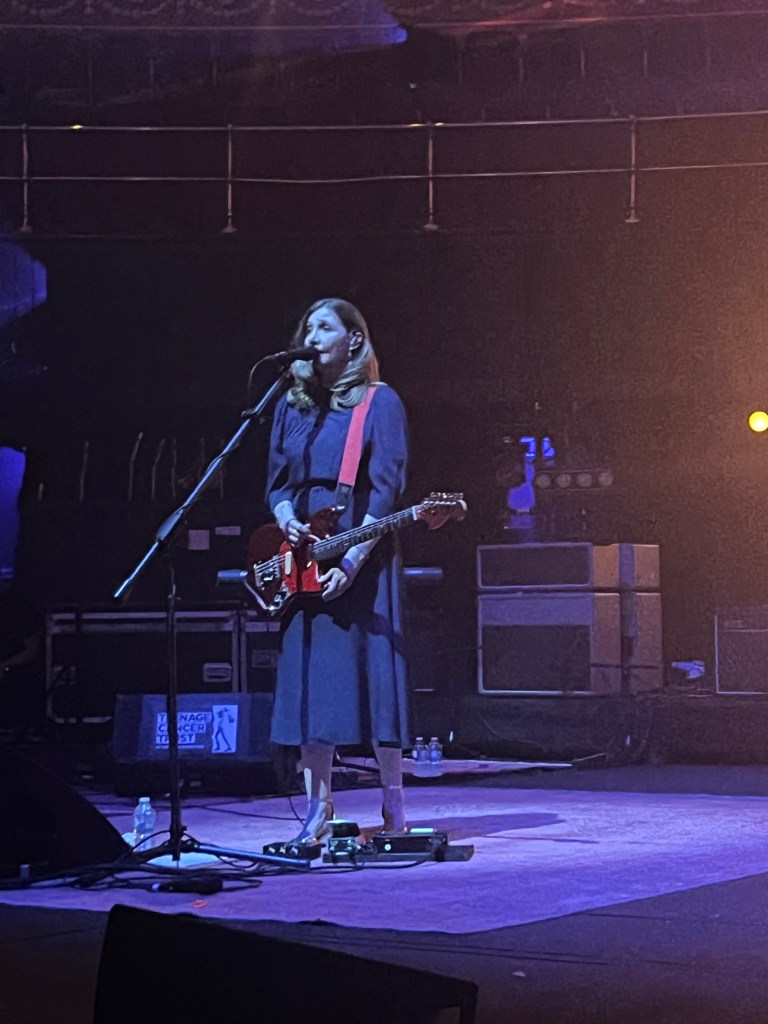
Half of the women I interviewed did not see themselves as “gearheads” or as having an extensive interest in equipment. They expressed preferences for and knowledge about certain amplifiers and chose to focus on learning about the gear that they perceived as being most relevant for achieving their own sound. One participant, however, expressed feeling pressure to learn as much about gear as possible in order to be taken seriously – this sense of having to work harder has proven to be a common theme. At the same time, there are women electric guitarists for whom an interest in gear is at the forefront of their creative practice and musical identities. Yvette Young features content about her guitar technique and gear on her social media accounts and has discussed her practices in detail in videos posted by VOX amps, for example. Women are also starting to be recognised with signature amp models, a similar concept to signature guitars, such as Orianthi’s Oriverb model with Orange amps.
Turning up = Taking Power
Amplification also matters because it is synonymous with musical power. As Paul Théberge (2011: 7) has pointed out, “‘Power’ … is both a description of a physical phenomenon and a cultural value, for it is only through the application of electric amplification to loudspeakers that both public and private spaces can be invested with a musical intensity unprecedented in cultural history.” Electronically amplified music that “glories in its loudness” means that musicians dominate aural (as well as physical) space and engage in acts of “aural-spatial domination” when they perform (Clawson 1999: 108). Following this, amplification functions as and enables a performer to create their own “sonic autonomy” (Fourie 2020: 42).
“I feel powerful. I feel like it’s like this thing that is an extension of like my mind and my voice … when it’s really plugged in, it gives me that feeling that I wanted …“
(C 2024)
As I’ve found through in-depth interviews and an analysis of media interviews in the guitar press, this factor plays a role in motivating and enabling women to become electric guitarists and is an important source of meaning in their practice. A few examples are quoted throughout this blog. These women specifically identify the loudness or volume associated with the electric guitar – and the sense of power it creates – as among the reasons they were attracted to the instrument and describe how it functions as a form of personal and musical expression and validation. While these quotes cite the “electric guitar” as the source of this loudness, volume and power, their statements ultimately refer to amplification. They show that it is the act of “plugging in” that really matters.
“Why I enjoy the electric guitar is because there’s more scope for you to be quite obnoxious and loud … That sensibility of being like, ‘I don’t give a fuck about what anybody thinks, this is my sound, it’s really tinny and distorted and I love it’”
(Aziya, Whitmore 2012).
 Amplification Project